Search permanent outdoor lighting and you will drown in options. Watts Lights. Govee. Enbrighten Eternity. Twinkly. eufy. Trimlight. JellyFish Lighting. Gemstone Lights. EverLights. Oelo. Celebright. They all promise app-controlled colour, schedules, and holiday magic. They all show beautiful photos at night.
So what is actually different? Less than the ads suggest in one area, and more than they admit in another. The app alone is not the difference. Almost every system on this list has a good app. The real differences are the track, the finish, the warranty, and who installs it, and the app experience itself, including who sets it up with you.
One point worth knowing up front: Watts Lights is a Canadian company, based in Calgary, and it is installed here by local certified dealers, not shipped from a warehouse and self-installed. That home-field difference runs through everything below.
The two kinds of permanent lighting
Strip away the branding and permanent-style lighting falls into two groups.
Professionally installed track systems. Lights mounted inside a colour-matched aluminum track, custom fitted to the roofline or fascia, installed by a dealer. Watts Lights, Trimlight, JellyFish Lighting, Gemstone Lights, EverLights, Oelo, and Celebright all work this way. In Canada, Gemstone, EverLights, Trimlight, and Inception Lighting have dealer networks, and Watts Lights is a Canadian company based in Calgary.
DIY retail kits. Lights you buy in a box and install yourself, usually with adhesive and clips. Govee Permanent Outdoor Lights (including the Pro and Elite models sold at Costco), Enbrighten Eternity from Home Depot, Twinkly, and eufy Permanent Outdoor Lights are the names you will meet most often. Philips Hue Festavia often shows up in these searches too, but it is a seasonal string light, not a permanent track system, so it is a different product wearing similar keywords.
Both groups can make a house glow at night. The differences show up in daylight, in year three, and when something goes wrong.
The track is the difference you see every day
A professional system hides its wiring inside a colour-matched track. During the day, the track blends into the fascia or soffit, and the house looks like itself, not like it is wearing decorations out of season.
A DIY kit is held on with adhesive and clips, and the wire between lights stays visible under the soffit. At night nobody notices. In daylight, everyone does, especially on a light-coloured soffit where a dark wire draws the eye along the whole roofline.
Some installers will put a retail kit like Govee into an aluminum track for you, which closes much of this gap. That is a legitimate middle option, and it is worth asking any installer about. But out of the box, the DIY kit is a clip system, and the professional system is a track system, and that is the first honest difference.
Light spacing changes the look at night
Professional systems typically space lights closer together, which produces a denser, more uniform glow along the roofline. DIY kits typically space lights further apart, which produces distinct cone or scallop effects on the wall. Neither is wrong, but they look different, and the look you want should be part of the decision. Ask to see both effects at night before you choose, not just in a product photo.
The app: both are good, and here is where Watts pulls ahead
Honesty first: Govee's app is good. It is mature, widely used, and on compatible models it supports Matter and voice assistants, with music sync, scene modes, and scheduling. If anyone tells you DIY apps are toys, they are selling you something.
Here is where Watts pulls ahead. The Watts app offers 16 million colours and over 1,000 presets across 21 categories, individual light and zone control, true warm white for everyday architectural light, schedules, and cloud control away from home. That depth matters in daily use: more presets means less fiddling, and zone control means the front entrance, the side elevation, and the back can each show what suits them.
But the bigger difference is not in the app at all. It is who sets it up with you. With a Watts installation, your installer programs the zones and schedules with you, shows you how it works on your own phone, and is there to call when you want to change something. With a DIY kit, you set it up alone, and support is a chat window. The app is only as good as the experience around it, and that experience is where Watts wins.
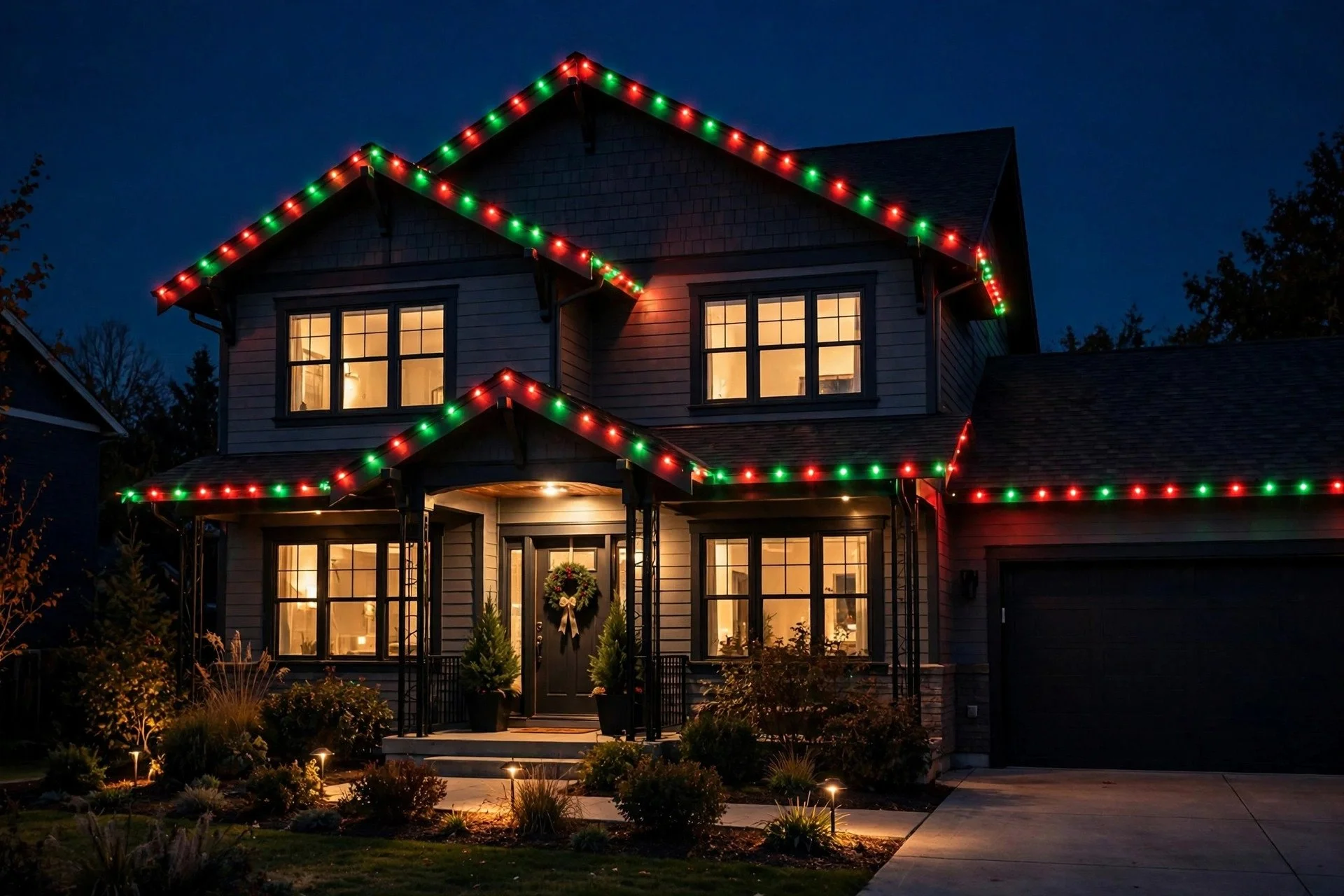
The same system in holiday colours.
Warranty and who answers the phone
Here the gap gets real. DIY kits carry manufacturer warranties measured in years, and support goes through the manufacturer or retailer. If a controller fails in year four, you are troubleshooting with a support chat and possibly buying a replacement yourself.
Professional systems commonly carry longer coverage, with several offering lifetime or decade-plus parts coverage, and the warranty path runs through a local dealer. When Reisinger Electric installs a Watts system, there is a local installer to call, not a ticket queue. That difference matters more the longer you own the system, because a permanent system is supposed to be permanent.
Price: compare the whole job, not the box
A DIY kit costs a few hundred dollars in materials for a modest roofline. A professionally installed system can start at a couple thousand for a smaller home and goes up with footage, design, and electrical work, quoted per home. Those numbers are not comparable on their own, and anyone who compares them directly is misleading you.
Yes, the professional system costs more, because you are getting more: the colour-matched track, the design, the installation, the warranty, and a local installer behind it. The real comparison is the whole job: the kit plus your weekend on a ladder, plus the track if you want one, plus what happens when something fails, versus a measured, installed, warranted system with a local installer behind it. Some homeowners will rationally choose the kit. Some will rationally choose the professional system. The mistake is choosing the kit while expecting the professional result.
Who installs it matters as much as what you buy
You have seen the signs all over town: "Christmas lights installed." Most of them are from power washing companies or property maintenance companies, not electricians. That matters, and it is worth understanding why, because this is where the difference between a light display and an electrical installation lives. Part two of this series goes deeper on this question.
A licensed electrician does electrical work. A maintenance company attaches lights. A hardwired permanent lighting system is electrical work: power supply sizing, circuit load, panel capacity, controller placement, weatherproof connections, and proper protection. In BC, regulated electrical work must be done by a licensed electrical contractor who can pull the proper permits. A power washing or property maintenance company is generally not a licensed electrical contractor, so it cannot pull permits or certify that work, even if it can physically attach lights to a house.
An electrician designs the system around your home's electrical system. Before a single light goes up, an electrician looks at what the panel can support, which circuits the system will use, and whether the house has the capacity for it. A maintenance company does not do that design work, because it is not qualified to. If your panel is already near capacity or your wiring is older, an electrician finds that out before installation, not after something fails.
An electrician prevents fires. A light installer does not. Proper connections, correct wire sizing, weatherproofing that survives a Lower Mainland winter, and protection against overloads are electrical work. They are also fire prevention. An installer who is not an electrician cannot offer that, and cannot spot the existing electrical problems that a professional would notice while on site.
Accountability is different. A licensed electrical contractor in BC is regulated by Technical Safety BC. You can look up the licence, and the licence can be taken away if the rules are not followed. A maintenance company offers no equivalent accountability for electrical work, and if unpermitted electrical work causes a problem, the insurance questions that follow are yours to answer, not theirs.
Support is different too. When Reisinger Electric installs a system, there is a local contractor who knows your home, your system, and your settings to call. When a seasonal installer moves on to the next job, or the next season, that continuity is gone.
A plug-in, low-voltage DIY kit is a different thing: anyone can install it, because it is not hardwired electrical work. But then you have no electrical design, no permit trail, and no local contractor standing behind the installation. If the system is hardwired, the installer should be an electrician. If it is not, you should know exactly what you are giving up.
The honest summary
If budget is the priority, the roofline is simple, and you are comfortable on a ladder, a DIY kit like Govee or Enbrighten is a rational choice. Expect visible wire in daylight, wider light spacing, and manufacturer support.
If the finish matters in daylight, you want dense, uniform light, longer warranty coverage, and a local installer to call, a professional track system is the rational choice. Expect a higher price and a quoted, measured installation.
If you want the middle path, ask an installer about putting a retail kit into an aluminum track. It is a real option that splits the difference.
Whoever installs a hardwired system should be a licensed electrical contractor. That is not a sales line, it is BC law, and it is the subject of part two.
“The app is only as good as the experience around it, and that experience is where Watts wins.”
The comparison, at a glance
| DIY kit (Govee, Enbrighten) | Professional track system (Watts) | |
|---|---|---|
| Company | Mostly US and international brands | Canadian company based in Calgary, installed by local certified dealers |
| Mounting and daytime finish | Adhesive and clips, wire visible under the soffit | Colour-matched aluminum track, wires concealed, blends into the fascia |
| Look at night | Wider spacing, distinct cone effects | Closer spacing, dense, uniform glow |
| App | Mature app, scenes, music sync, Matter on compatible models | 16 million colours, 1,000+ presets across 21 categories, individual light and zone control, true warm white, set up with you by your installer |
| Warranty and support | Manufacturer warranty measured in years, support through the manufacturer | Longer coverage through a local dealer, a local installer to call |
| Installation | Your weekend on a ladder | Measured, designed, and installed by a licensed electrical contractor with permits |
| Price | A few hundred dollars in materials | Starting at a couple thousand for a smaller home, quoted per home, and you are getting more |
| Best for | Budget priority, simple roofline, comfortable DIY | Finish in daylight, dense uniform light, warranty, and local support |
Talk through your home
Reisinger Electric is a certified Watts Lights installer serving Surrey, Langley, and the Lower Mainland. We will talk through the options honestly, including when a DIY kit is the right answer for your home.
Call (778) 805-7074 to talk through your property and request a quote.