In the Lower Mainland, power outages rarely arrive with a blizzard. They arrive with a windstorm. A wet November night, trees down across lines, and suddenly the house is dark, the fridge is warming, the heat is off, and the phones are the only light in the room.
Check the BC Hydro outage list to see current outages before calling about the power.
Most outages are short, and most households ride them out with candles and patience. But for some homes, an outage is more than an inconvenience: electric heat that stops on a cold night, a home office that cannot afford a lost day, medical equipment that cannot wait, or a strata building full of residents asking what happens next.
That is the situation a standby generator is built for.
Nobody has to go outside in the storm, nobody has to pull a starter cord in the rain, and nobody has to decide what to plug in first.
What is a standby generator?
A standby generator is a permanent unit installed outside the home, connected to the electrical system and to a fuel supply, usually natural gas or propane. It is not a portable generator you wheel out of the garage. It sits there quietly, monitors the power coming into the house, and starts automatically when that power fails.
When the power goes out, an automatic transfer switch disconnects the house from the grid and connects it to the generator. When utility power returns and stabilizes, the switch moves the house back and the generator shuts itself down. Nobody has to go outside in the storm, nobody has to pull a starter cord in the rain, and nobody has to decide what to plug in first.
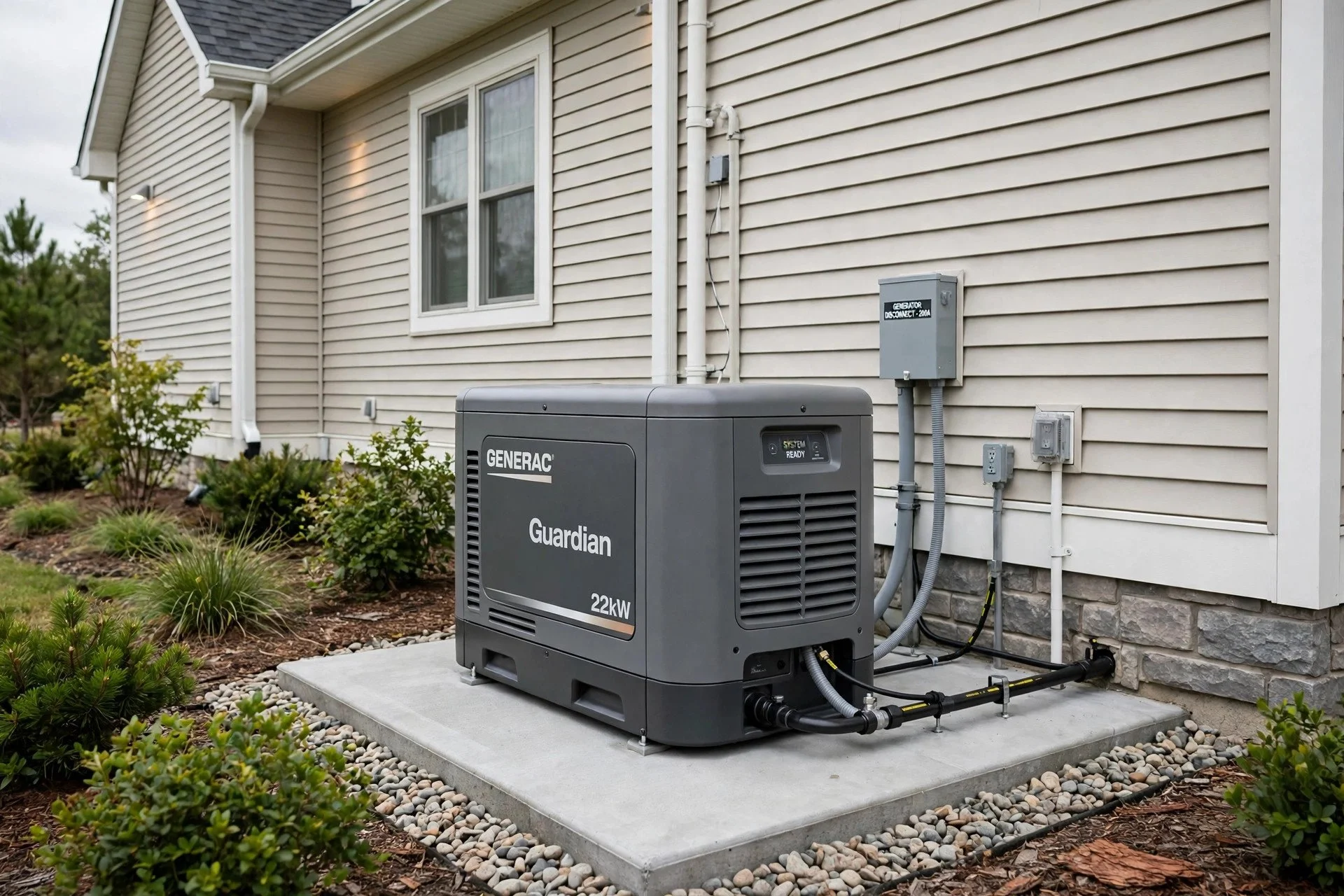
A permanent unit on a pad, wired in and ready.
What does it actually power?
That depends on the size of the unit and how it is set up. Some installations cover selected essentials: heat, refrigeration, lighting, communications, and a few key circuits. Larger installations can cover the whole home. Sizing is a real design decision, not a guess, and it starts with what the household actually needs during an outage and what the electrical system and fuel supply can support.
This is also why a standby generator is a project, not a purchase. The unit, the transfer switch, the fuel connection, the placement, and the electrical work all have to be designed together.
How is it different from a portable generator?
A portable generator can be useful, and for some households it is the right answer. But the differences matter, especially in a storm:
A standby generator starts itself. A portable generator waits for someone to set it up, fuel it, and start it, in whatever weather caused the outage.
A standby generator connects through a transfer switch, so the house wiring is powered safely. A portable generator powering a house without proper connection can backfeed the grid, which is dangerous for utility crews and illegal.
A standby generator runs on a connected fuel supply. A portable generator runs on gasoline you have to store, pour, and refill.
A standby generator exercises itself on a schedule, so it is ready when it is needed. A portable generator that sat in the garage for two years may not start at all.
What does installation involve?
A standby generator installation is electrical work, fuel work, and placement work, done as one project. In BC, the electrical side should be done by a licensed electrical contractor who pulls the proper permits. The unit needs a suitable location with clearances, a fuel connection, and a transfer switch integrated with the panel. After installation, the system is commissioned and tested, and it runs regular self-tests to confirm it is ready.
The right time to have that conversation is before storm season, not during an outage. Once the wind is up and the power is out, installers are busy and the household is already in the dark.

The house keeps running while the storm carries on outside.
Is a standby generator right for your home?
It depends on how your household uses power, what an outage costs you, and what your property can support. Homes with electric heat, home offices, or equipment that cannot lose power have the strongest case. Some households decide a portable unit is enough. Others want the house to simply carry on as if nothing happened.
Either way, the decision starts with a conversation about the house, not a product page.
Talk to a Generac partner
Reisinger Electric is an official Generac partner. We design and install standby power for homes across Surrey, Langley, and the Lower Mainland.
Call (778) 805-7074 to talk through your home and what standby power would look like for it.