A homeowner who loses power loses an evening. A business that loses power loses money, and it loses it by the hour. In the Lower Mainland, that usually happens on a wet, windy night, when a storm takes down lines and the neighbourhood goes dark. The question for a business owner is not whether the power will come back. It is what the business loses while it is gone.
A homeowner who loses power loses an evening. A business that loses power loses money, and it loses it by the hour.
What an outage actually costs a business
It depends on the business, but the list is familiar to anyone who has lived through one:
Refrigeration. Restaurants, grocers, cafes, and food processors watch stock spoil as coolers warm. A few hours can mean thousands of dollars of inventory, and a health question about everything that stayed in the danger zone.
Sales. No power means no point of sale, no card payments, no phones, and often no customers, because a dark storefront reads as closed. Staff are on the clock with nothing to sell.
Security. Alarms, cameras, and lighting go down together. A business that is dark and unalarmed during a storm is a target, and the owner knows it.
Buildings. For strata and commercial properties, an outage can mean elevators stopped, parkade gates stuck, emergency lighting on battery, and residents or tenants asking what happens next. The property manager's phone does not stop ringing just because the power did.
Data and operations. Offices lose servers, phones, and work in progress. A day of lost productivity across a team is a real cost, even if nothing spoils.
How commercial standby power works
A commercial standby generator is a permanent unit installed at the property, connected to the electrical system and to a fuel supply, usually natural gas or propane. An automatic transfer switch monitors utility power. When it fails, the switch moves the building to generator power. When utility power returns and stabilizes, it switches back. Nobody has to go outside in the storm to start anything.
What the generator powers depends on the size of the system and how it is designed. Some businesses cover essentials: refrigeration, lighting, security, communications, and key equipment. Larger installations cover the whole operation. Sizing is a design decision based on the building's loads, including motors and refrigeration equipment, which draw far more power starting up than running.
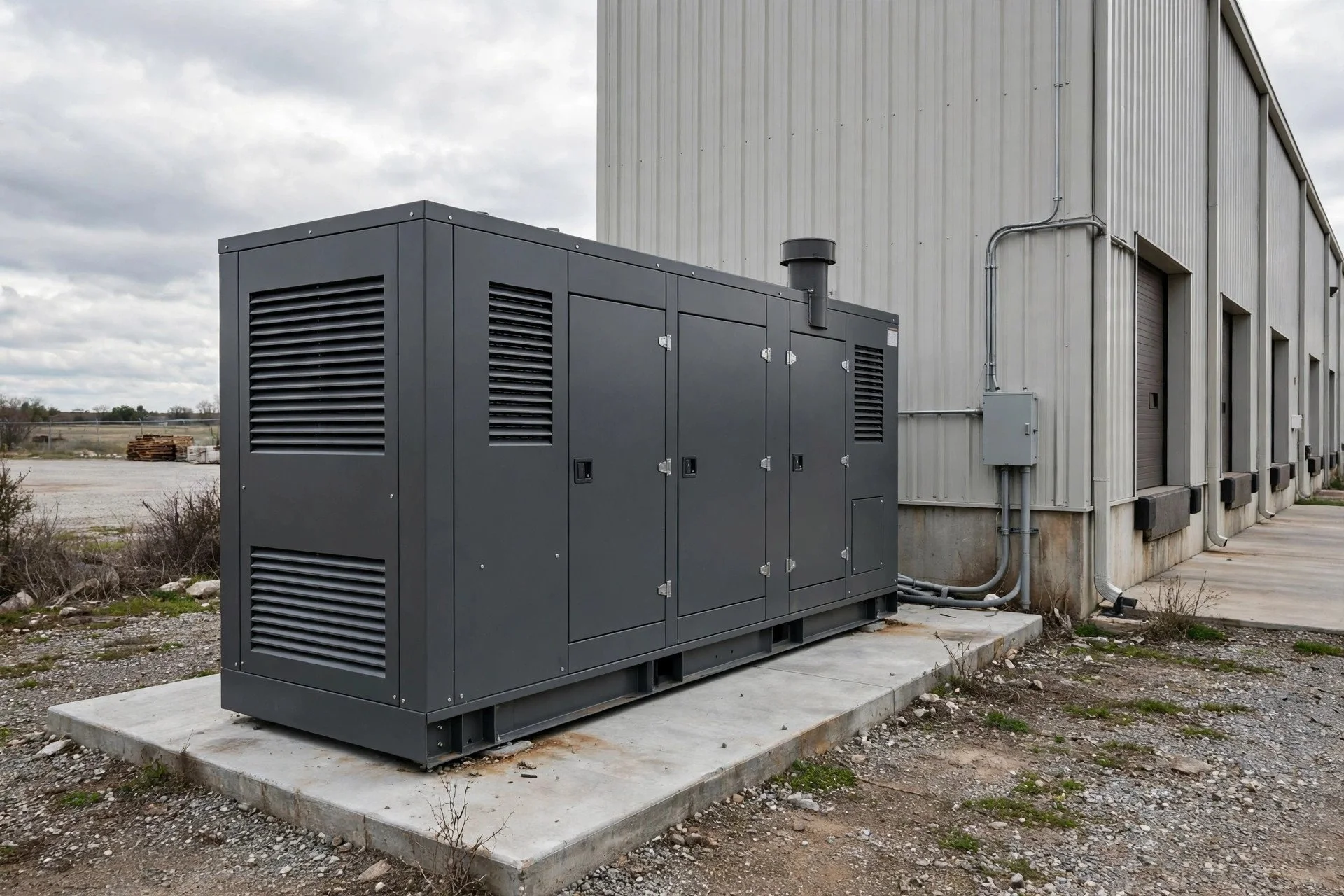
A commercial unit on a pad, sized to the building’s loads.
Why a business case is different from a home case
A homeowner buys peace of mind. A business buys continuity, and continuity has a number attached to it. The honest way to think about a commercial standby system is to compare its cost against one bad outage: the spoiled stock, the lost sales day, the staff hours paid for nothing, and the customers who went to a competitor that stayed open. For many businesses, a single storm season answers the question.
There is also a reputation angle that does not show up on a spreadsheet. The restaurant that stays open during an outage, the grocer whose freezers never wavered, the building whose lights never went out: customers remember that. So do tenants.
What installation involves
A commercial standby installation is electrical work, fuel work, and placement work, done as one project. In BC, the electrical side should be done by a licensed electrical contractor who pulls the proper permits. The unit needs a suitable location with clearances, a fuel connection, and a transfer switch integrated with the building's electrical system. After installation, the system is commissioned, tested, and set to run regular self-tests so it is ready when it is needed.
The right time to have that conversation is before storm season, not during an outage, when installers are busy and the business is already losing money.
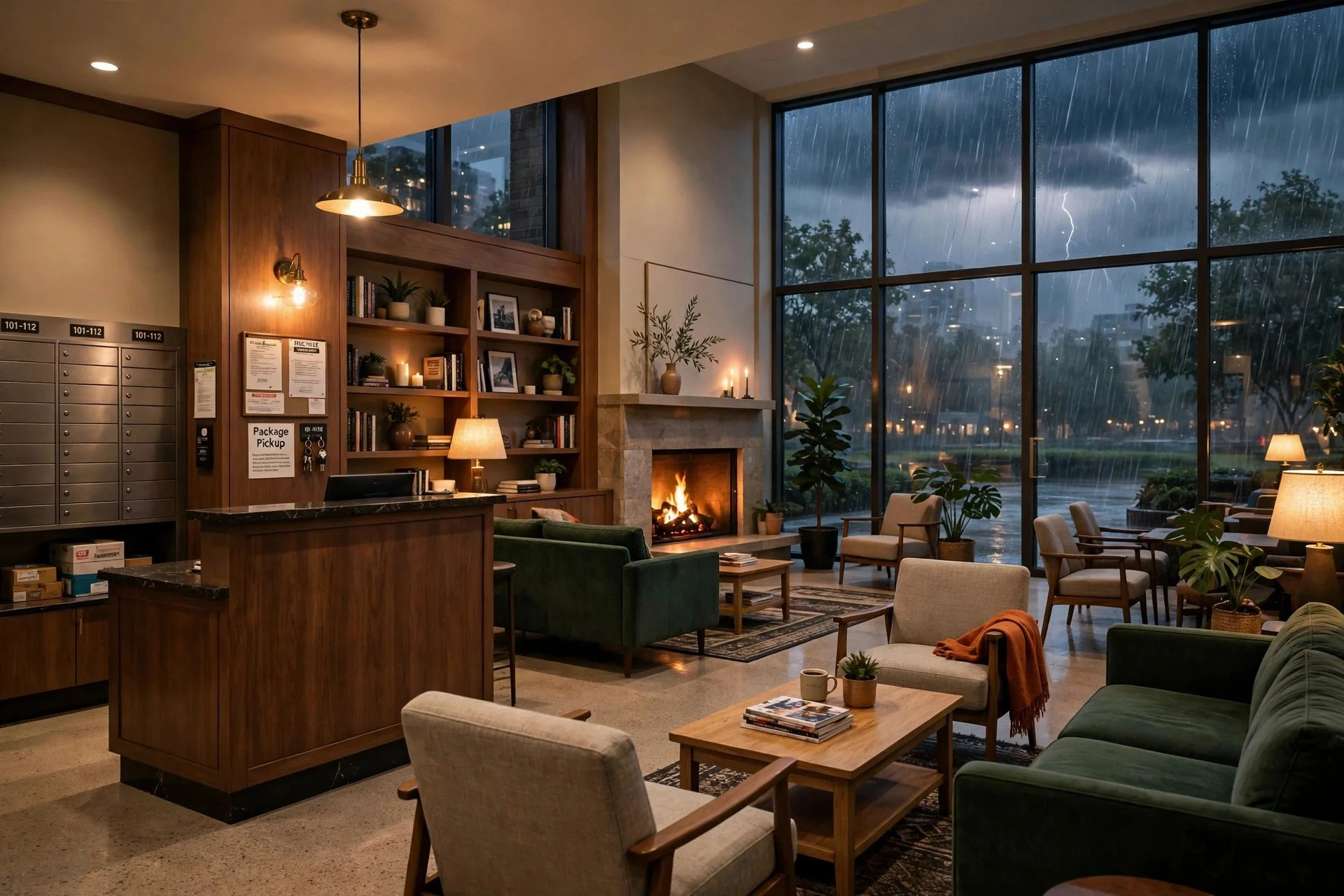
Common areas and tenant spaces stay lit through the storm.
Talk to a Generac partner
Reisinger Electric is an official Generac partner. We design and install standby power for businesses, commercial properties, and strata buildings across Surrey, Langley, Abbotsford, and the Lower Mainland.
Call (778) 805-7074 to talk through your property and what standby power would look like for it.